Policy and Research Context
Approach
As part of her extended tenure, the Scottish Veterans Commissioner (SVC) has undertaken a short review on veterans and employment. It is recognised that veterans and their families make a valuable contribution to Scotland’s economy and can bring a breadth of skills, experience, and knowledge to an organisation as employees.
This review picks up on the themes and recommendations outlined in previous work by the SVC, with a focus on what has changed and improved over the last few years. It looks at employment for the veteran community, including those transitioning from Service into civilian life, and seeks to highlight good practice and suggest areas which require development.
Throughout the research and investigation that supported previous thematic reports published by the Scottish Veterans Commissioner, it has been important to find a balance between focusing on the challenges and barriers faced by the veteran community in Scotland, as well as promoting and celebrating the positive contribution they make to civilian society.
To inform this report the Office of the Scottish Veterans Commissioner has carried out a programme of external engagement with a range of stakeholders, alongside examination of relevant research and data. Due consideration has also been given to government policies and programmes at both a UK and Scotland level. This has included looking at any data available on veteran employment, reviewing programmes delivered in support of this community and looking at other sources of support and advice.
Policy Context
Scottish Veterans Commissioners have completed a number of reports and reviews in which the challenges and opportunities of gaining and retaining post-Service employment have been considered. Most recently, in ‘Veterans and the Law’ (2024) and ‘Veterans and Finance’ (2025), the Commissioner was able to highlight the many opportunities available to Service leavers in these sectors as well as showcasing some employers who actively recruit and support them. These included Barclays and Police Scotland. However, the last substantive SVC report on employment was in 2020 and much has changed since then.
This review aligns with the Employment, Education and Skills theme in the current Scottish Government Veterans Strategy Action Plan:
- Military service fosters leadership, organisational skills, resilience and specialist skills such as medical or technical expertise. Veterans – and their families – are great assets for all employment sectors, and a growing number of employers are actively targeting veterans to fill their skills gaps. Continued development beyond military service can also include a number of education options, both for the Service leavers and their families. It is also important to recognise that, during their school education, children of Service personnel and veterans sometimes need additional support to overcome the challenges arising from military life.
- Outcome: veterans enter appropriate employment and can continue to enhance their careers throughout their working lives.
This review also supports the core principle of the Armed Forces Covenant that Service should result in no disadvantage when returning to civilian life.
The UK Veterans Strategy (updated in February 2026) commits to a more joined-up approach, with employment positioned as a core pillar of long-term veteran wellbeing and economic contribution.
As noted in previous reports, civil service employers can utilise the UK Government ‘Great Place to Work for Veterans’ Scheme’. This allows veterans who meet the minimum criteria for a role to progress directly to the next stage of the recruitment process. The ‘Going Forward into Employment’ programme is also in place for the civil service and provides opportunities for groups of people who may experience barriers to finding employment. Veterans (and their spouses) are one of the groups included in the scheme as some may struggle to make the transition to civilian employment. The programme provides work placements and fixed term contracts for up to 24 months and can lead to permanent employment. Both initiatives support veterans to access a wide range of employment opportunities within those organisations, bringing their skills, training, and qualifications to a sector where they can add value. As at the end of July 2025, there were at least 138 veterans of the regular armed forces and 54 veterans of the reserved armed forces working in the Scottish Government.
The Scottish Government approach to transforming employment support in Scotland ‘No One Left Behind’ is intended to underpin effective and joined-up employability support across Scotland. It has a crucial role in achieving their vision for economic transformation and tackling child poverty; and aims to deliver a system that is more tailored and responsive to the needs of people of all ages who want help and support on their journey towards, into and in work – particularly people with health conditions, disabled people and others who are disadvantaged in the labour market. Veterans can be supported by this approach, as part of the civilian community.
As part of Scotland’s Devolved Employment Service: Statistical Summary Series, data on Armed Forces veterans for No One Left Behind were reported for the first time in February 2024. In the most recent reported quarter (July to September 2025), 68 people (1%) reported being an armed forces veteran, while 5,670 (96%) reported not being an armed forces veteran. This information was unknown for 183 people (3%). The proportion of people reporting being an armed forces veteran has consistently been around 1% since this collection was introduced. As veterans make up 3.8% of the population in Scotland this would suggest they are under-represented in these statistics.
SVC Progress Reports
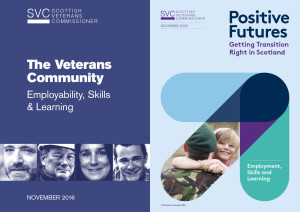 Reports by previous Scottish Veterans Commissioners on this topic were ‘The Veterans Community – Employability, Skills and Learning’ in November 2016 and ‘Positive Futures: Getting Transition Right in Scotland: Employment, Skills and Learning’ in December 2020, and these resulted in 29 recommendations that were accepted by the Scottish Government. These are assessed annually and progress is reported on through digital reports on the SVC website.
One of the recommendations from the 2016 report was that the Scottish Government should ‘establish a Veterans Employability Strategic Working Group of key partners to provide strategic leadership and to oversee the activity required to fulfil the ambitions of more, and better, employment’. The Veterans Employability Strategic Group (VESG) was announced in 2017; however, it has not met since 2022. The VESG provided strategic oversight resulting in positive achievements such as the Qualifications and Skills Discovery Tools outlined below. Stakeholders have put forward differing views on the future of the VESG.
The most recent progress assessment of the SVC recommendations, in September 2025, noted continuing work to support spouses and partners, as well as Early Service Leavers, who may face particular challenges in the labour market. The Scottish Credit and Qualifications Framework Partnership’s (SCQFP) Qualifications Tool can be found on the My World of Work website sitting alongside the Skills Discovery Tool, helping veterans translate their military qualifications for the civilian job market.
In recognising that a meaningful civilian career for members of the veteran community is one of the most important elements of a successful transition, it was encouraging to see ongoing work across employment, skills and learning. However, the progress assessment concluded that a more formalised structure was needed to provide strategic leadership and direction and that stronger oversight and clearer collaboration across public, private and third sector partners is needed to drive sustained improvement.
Research Context
Veterans form an important component of Scotland’s labour market, with census data confirming a sizeable population distributed across all regions. Their participation in the labour market is comparable to non-veterans, indicating that they are an active and reliable workforce cohort. Additionally, evidence consistently shows that hiring veterans generates tangible business benefits. Surveys indicate that 91% of employers experience improved organisational performance, citing stronger work ethic, discipline and problem-solving capabilities. These attributes contribute to higher productivity, better team performance, and organisational resilience, particularly in complex or high-pressure sectors.
 In October 2024, the Centre for Evidence for the Armed Forces Community published policy and research summaries: ‘Post-Service Employment among ex-Service personnel and their partners’. These comprehensive and peer-reviewed reports draw from existing research evidence and current policy and support for UK ex-Service personnel. The reports set out key findings and recommendations, with a focus on the need to map support services and improve data capture and outcome measurement (in particular longitudinal employment data), improve evaluation in support of continuous improvement, redefine definitions of ‘success’ in this area, and better understand the barriers to engagement.
Drawing from the findings in their 2025 report ‘Understanding the Transition from Military to Civilian Life’, Forces in Mind Trust (FiMT) published a policy brief on employment support in May 2026. This summary outlines six key policy issues:
- Underemployment and uneven progression
- Lack of localised cohort-specific support
- In-career preparation, timing and notice constraints
- Lack of employer awareness and understanding of transferable skills
- Inconsistent tracking of employment outcomes
- Lack of employment support for partners
The FiMT research shows that progress has been made in strengthening employment support, but offers recommendations that include reframing measures of success, strengthening employer engagement and targeting localised support for specific cohorts.
The Centre for Evidence for the Armed Forces OUTCOMES Study was conducted in 2024/25 to explore the perceived benefits of military service. It identifies military Service as a source of exceptional experiences, high level and unique skills (including technical and interpersonal skills), a strong work ethic, a desire to give back and go above and beyond, and strong values.
Research demonstrates that veterans bring real value to the civilian workforce through leadership capability, reliability, adaptability, and mission focused performance. The primary barrier is not capability, but translation and utilisation of that capability.
Experiences of post-Service employment are varied and unique to each veteran. There are many factors affecting employment outcomes such as:
- Employment after lengthy or full career
- Employment after leaving Service early
- Employment by gender
- Spousal and partner employment
- Employment after discharge due to injury or illness
While experiences and outcomes differ, research has shown that there are some shared themes which can impact on gaining and retaining employment after Service. These themes are drawn together in the table at Appendix 1.
Almost all working-age veterans hold recognised qualifications and/or have developed practical and transferable skills through experience. This reduces the need for extensive training and accelerates onboarding. Given that many firms spend substantial sums on workforce training each year, recruiting veterans can deliver both highly effective, productive staff and direct financial savings. From a labour market perspective, veterans play a key role in addressing structural skills shortages. They are overrepresented in sectors critical to Scotland’s economy including construction, transport, and health and social care.
In serving their country, invaluable behaviours such as dedication, attention to detail and loyalty become inherent, resulting in veterans being well placed to fill existing skills gaps in Scotland’s workforce. In the delivery of Scotland’s economic priorities, including infrastructure, public service capacity, and regional economic resilience, veterans are a significant and valuable resource.
However, despite these advantages, there is evidence of underutilisation of veteran talent. In the UK Veterans’ Survey 2020, over half of veterans reported working in roles below their skill level, often due to difficulties translating military experience into civilian employment. This suggests a potential missed economic opportunity, as better alignment between skills and roles could significantly increase productivity without increasing labour supply.
Research indicates that employing veterans delivers clear economic benefits for Scotland, including improved productivity, reduced training costs, and enhanced capacity to address skills shortages. Veterans constitute a high-quality, work-ready talent pool with strengths in leadership, technical capability, and resilience.
Entrepreneurship and Business Ownership
British Veteran Owned, a not-for-profit social enterprise that supports veteran owned businesses across the UK, has recently produced ‘The Economic Power of UK Veteran-Owned Businesses’. Their comprehensive analysis suggests that 340,000 veteran entrepreneurs are generating £7 billion+ in turnover whilst achieving exceptional survival rates and creating tens of thousands of jobs. The report sets out key highlights around economic impact, longevity, and rates of return. However, it also flags that there may be some structural barriers at play as veterans are less likely to be self-employed (17% vs 23%).
There was interest in this in the last session of the Scottish Parliament, where data collection about veteran-owned businesses was raised with the then Veterans Minister. This was subsequently followed up in a parliamentary question where the Scottish Government advised that: ‘The Scottish Government does not currently gather data specifically relating to the activity of veterans’ start-up businesses, however we know from Scotland’s Census in 2022 that around 10,000 veterans identified as self-employed. With a new UK wide Veterans’ Strategy published in November 2025 and a Scottish Government commitment to refresh the 2022 Action Plan this year, the range of information gathered in relation to veterans in Scotland will be considered. We will, in formulating our Action Plan, be considering whether we need data to either assess whether there is any disadvantage faced by veterans in establishing businesses or in order to pinpoint success worth celebrating.’
This can also extend to partners and spouses of members of the armed forces, who often experience very disrupted career patterns as they move around with their family. ‘Community and Relationships: Anything but Uniform (2024)’ identified this challenge and noted that: ‘Support should be available for military partners setting up businesses in Scotland. While not for everyone, setting up in business is an effective way to overcome the disadvantage of being a Service, then veteran, partner. Self-employment has several advantages for the military family and the Scottish economy: it can be more flexible; can be portable; supports the local economy; supports effective transition by providing one stable income and can encourage veteran families to stay in Scotland when a business becomes established.’