Employment Support and Outcomes
Statutory Provision
The Career Transition Partnership (CTP) is the official resettlement service for the armed forces and is delivered through a partnership between the Ministry of Defence (MOD) and Reed in Partnership, combining government oversight with specialist employment expertise.
The current CTP contract has been in place since October 2024, and Forces Employment Charity is a key delivery partner. CTP supports Service leavers who are transitioning from their military career into civilian employment, further education or retirement and provides structured career support to help individuals identify suitable civilian pathways that match their skills, experience, and aspirations. Support typically includes:
 One to one career advice and guidance
- Workshops and training courses (e.g. CV writing, interview skills, skills translation)
- Access to a dedicated jobs portal with veteran friendly employers
- Resettlement events, employer briefings, and job fairs
- Digital self-service tools for career planning and job search
The most recent published statistics confirm that in 2024/25 there were 14,588 Service leavers across the UK eligible to use the CTP service, with 10,208 of those choosing to access the support available. 86% of regular Service leavers who had used the CTP service and reported their outcomes after 6 months were in employment.
The maps at Appendix 2 show the resettlement locations of Service leavers in Scotland between October 2024 and September 2025 who disclosed a post-discharge address to CTP.
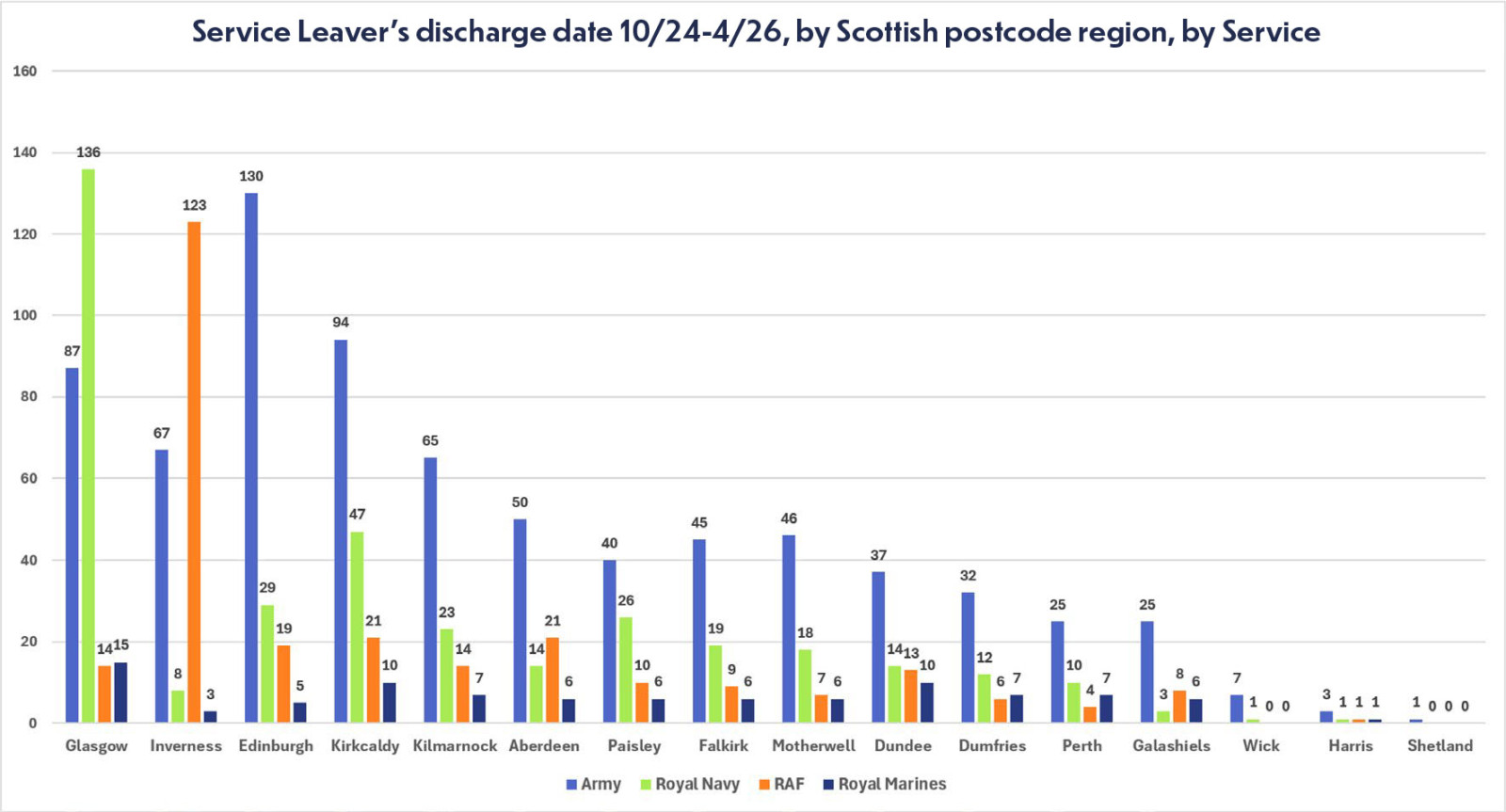
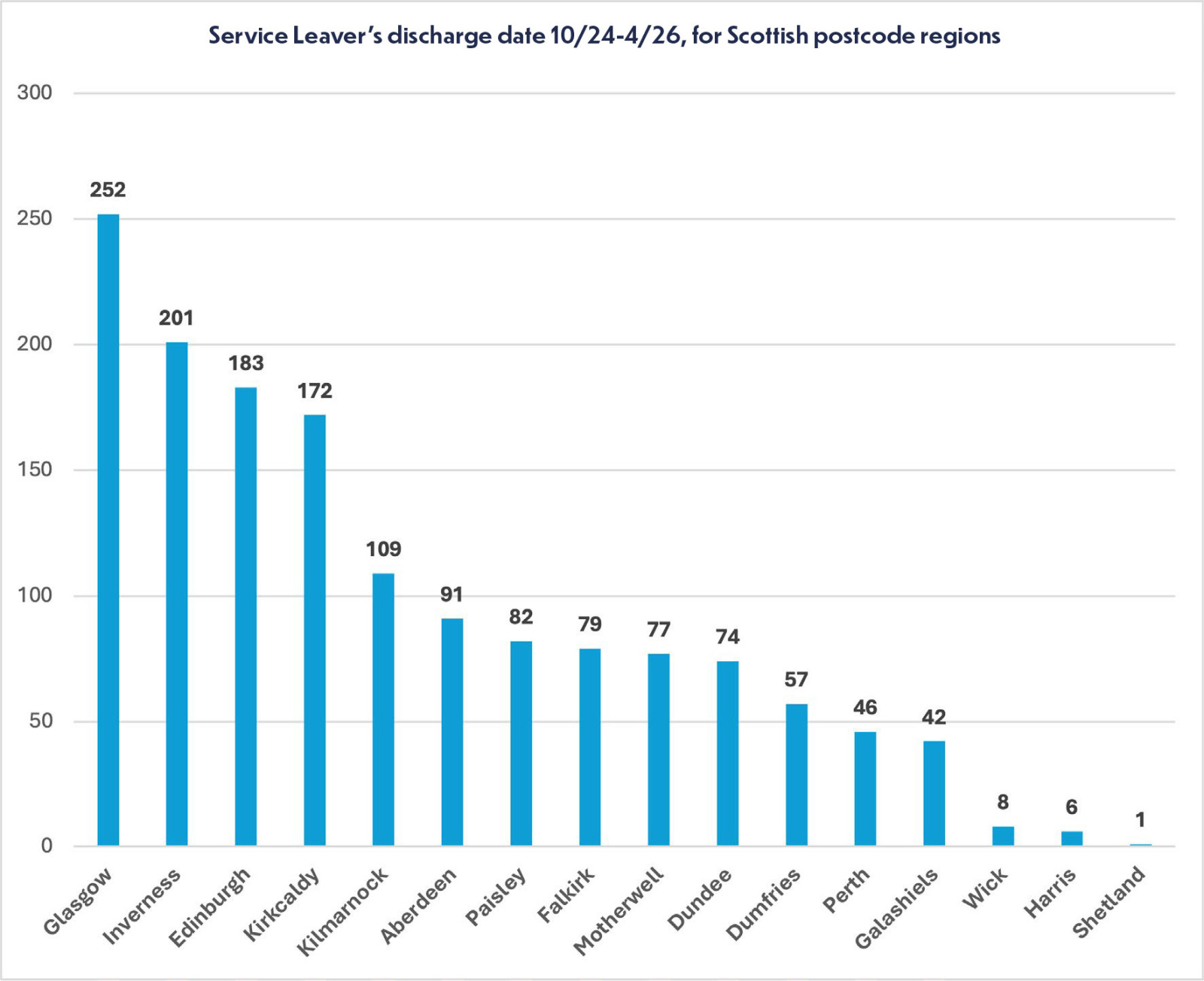
Post discharge information provided by Service leavers suggests that the numbers of Service leavers settling in Scotland between October 2024 and April 2026 were 1,480. The majority (754) were from the Army. This is broken down in more geographic detail in the tables below.
Management information provided by the MOD notes that since the new contract commenced in October 2024 there have been 1,338 referrals through the Regional Resettlement Centre in Rosyth, which covers the whole of Scotland. 1,126 of these were through the core resettlement programme, the others through more specialist support programmes.
50 Career Transition Workshops (CTW) have taken place with 419 Service leavers attending. Satisfaction rates for the events have been high. In the first year of the contract over 113 employers covering 46 industries participated in the programme, with 1,049 vacancies being made available to Service leavers. In Scotland, 84% of regular Service leavers who had used the CTP service and reported their outcomes after 6 months were in employment, 2% were in education and 2% had retired.
Forces Employment Charity also delivers ASCEND on behalf of the UK Office for Veterans Affairs. Funded through the Armed Forces Covenant Fund Trust, this programme serves as an extension to CTP for veterans and their families across the UK by providing a free careers service and access to recruitment pathways.
The Defence Employer Recognition Scheme (ERS) acknowledges employers that pledge, demonstrate or advocate support to defence and the armed forces community and align their values with the Armed Forces Covenant. The scheme recognises the different levels of commitment provided by employers; this is done through a 3-tier approach of bronze, silver, and gold awards. Those employers with a gold award are required to be an exemplar within their sector. They should be an advocate for a forces friendly workplace through their engagement with partner organisations, suppliers and customers.
This role is particularly influential, as businesses tend to respond more positively to insights from other successful organisations than to guidance from statutory bodies. There is already evidence of effective practice in this area, alongside clear opportunities to expand and strengthen these efforts. In particular, the informal networks that Gold Award employers naturally maintain – across supply chains, contractors, and partner organisations – offer valuable channels through which advocacy can be amplified and embedded more widely.
Third Sector Support
There are a number of third sector organisations that support Service leavers and veterans to gain training, qualifications and employment. It would not be possible to list them all. They do so in a variety of ways and often combined with other types of support.
Veterans Scotland has a ‘Support and Employment’ group that brings together member organisations who provide practical support to veterans, including those seeking employment. This helps to encourage collaboration and the sharing of information and good practice, as well as providing a forum to identify priorities and challenges.
Officers Association Scotland (OAS) is a good example of the type of support available to members of the veteran community. It supports officers and their families in many ways, including in the area of employment. It is worth noting that all training, networking sector insights, and employer events are open to all members of the military community, regardless of rank. A range of employment support is available, including training and learning events, bursaries, access to vacancies, networking and mentoring opportunities, and sectoral guides.
Through its new 5 year strategic plan, OAS remains firmly committed to providing personalised support for its clients. Ongoing developments in working practices have seen continual increases in registered clients and it is also seeing a consistent increase in the number of employers recognising military recruits are good for business. OAS has streamlined its provision, ensuring that more individuals can access support whilst also using its experience and credibility to share learning and improve provision at all levels.
OAS has continued to transform the way it works, with an enhanced training and support model which includes e-resources, monthly webinars, and a mixture of face to face and online training workshops to a growing audience. 2025 saw the launch of its podcast series ‘Combat Boots to Business Suits’ which has garnered a considerable audience across the globe. 10 episodes convey a range of experiences including job hunting, how to start your own business and insights from an HR Director.
Activity in the last year has included:
- Hosting 6 face to face Employer events with approximately 946 attendees throughout the year, enabling multiple job opportunities for officers and non-commissioned officers.
- Participating in 15 external networking events across the UK promoting the value of employing officers.
- Hosting 26 monthly networking opportunities to support those transitioning or looking for a career change.
- Liaising directly with 233 employers to highlight the benefit of recruiting officers.
- Offering 4,224 Scottish employment opportunities through the jobs board.
- Delivering 56 webinars, training, and events to 2,779 clients in utilising CV and interview experience, how to find a job, cyber security, risk and resilience, humanitarian aid, and defence insights.
- Offering direct support to 9 spouses or partners to enhance their employment opportunities.
Another example is SSAFA, the Armed Forces Charity, who support individuals towards positive employment outcomes. SSAFA’s Mentoring Service is its primary employment-focused service, while also providing broader transition support. The service provides practical help with job applications, CV writing, and interview preparation, alongside guidance to help individuals understand the differences between military and civilian employment, including variations in salary, culture, and job expectations. Volunteer mentors also provide signposting and referrals to specialist organisations and employment support services where appropriate.
More broadly, SSAFA recognises employment as both an outcome and a means of improving wider wellbeing, financial stability, and independence. SSAFA works in partnership with other organisations across Scotland, recognising the importance of
collaboration and coordination in the delivery of holistic and person-centred support.
SSAFA’s Scottish Regional Office (SRO) and Branch Network provide welfare support through casework, enabling access to services through referrals and collaboration with other armed forces charities and statutory bodies across Scotland. Funding can be made available to remove barriers and make employment a realistic possibility in the future.
Those who engage with SSAFA Glasgow’s Helping Heroes (GHH) tend not to be pre-employment ready at the point of referral or self-presentation. Individuals often present with significant unmet needs that must be addressed before employment can be a realistic or sustainable goal. Staff focus on developing the conditions required for employment readiness. This includes stabilising housing and income, resolving benefits issues, providing realistic information about in-work entitlements and transitions, addressing health and wellbeing needs, rebuilding confidence, and supporting individuals to explore employment at a pace they feel able to manage.
These are just a few examples of the kind of specific statutory and third sector support available to veterans and their spouses/partners. There are many more organisations who do this very effectively. Veterans can, of course, also access the range of mainstream pathways for training, skills and employment support that are available in Scotland.